Latest Kitchen Updates @ Cuisine Paradise

Monday, 31 January 2011

Five Treasure Soup

This is the 4th random recipes that I have picked up from Philips, MyKitchen (www.philips.com.sg/kitchen) recipes site. Since this Thursday is Chinese New Year, I am sure most of you would like to prepare one or two simple Chinese New Year Auspicious soup to impress your guests during mealtimes. For example: The Lotus Root symbolise abundance and unity while Dried Scallop on the other hand means gold and wealth.

This is a very simple and delicious soup which requires minimum effort in preparation. As you can see from the photo there are about 4 main ingredients such as "Chicken", "Lotus Roots", "Dried Scallop" and "Shiitake Mushroom" and I make use of some ingredients that has natural sweetness and fragrant like Sweetcorn, Water Chestnut and Red Dates to flavour the soup instead of stock cubes.

Ingredients: (serves 4)
2000ml Hot Water
2 Skinless Chicken Drumstick with Thigh, washed and trim
300gm Fresh Lotus Root, cut into thick slices
6 Fresh Water Chestnuts, skin removed lightly smashed
2 Corn Cobs, washed and cut into sections
3 Dried Shiitake Mushrooms
3 Medium Dried Scallop
4 Red Dates
1/2 Tablespoon Wolfberries


To prepare this soup without running to and from the stove to check the heat and etc, it would be great if you have a Philips brand or any other suitable rice cooker that has "SOUP" cooking function. As what you need to do is just put everything in and press COOK which you can refer to a similar cooking instruction by MyKitchen below.

But don't worry if all you have is only stove or slow-cooker, you can still cook this soup by following the method shown.

Method:
1. Wash the lotus roots thoroughly, making sure there is no soil in the holes. Cut the lotus roots into 1cm thick slices. Discard the ends.
2. Wash and clean all ingredients thoroughly with tap water.
3. Blanch chicken pieces briefly into boiling water before cooking.
4. Bring 2 litres of hot water to boil in a large soup pot, add in all the ingredients except wolfberries and let it simmer on low heat over the stove for about 1 hour or so. OR
5. For slow-cooker, cook it on AUTO for about 2 hours, stirring the mixture at least twice during cooking time to make sure the ingredients are evenly cooked through.


ORIGINAL RECIPE FROM PHILIPS (MyKitchen):

Five Treasure Soup


Preparation Time: 15 Minutes                         Cooking Time: 1.5 hours

Ingredients: (Serves 5)
2200ml Hot Water
3 Cubes Chicken Seasoning
2 Skinless Chicken Breasts, washed and cut into quarters
300gm Fresh Lotus Root, cut into thick slices
1 Peeled Carrot, cut into wedges
2 Corn Cobs, washed and cut into sections
4 Seeded Red Dates
3 Dried Shitake Mushrooms

Method:
1. Wash the lotus roots thoroughly, making sure there is no soil in the holes. Cut the lotus roots into 1cm thick slices. Discard the ends.
2. Wash and clean all ingredients thoroughly with tap water.
3. Blanch chicken pieces briefly into boiling water before cooking.
4. Put the hot water, the chicken cubes, the blanched chicken pieces and the last 5 ingredients into the inner pot of the rice cooker. Close the lid.
5. Press the MENU button to select the SOUP cooking mode. Press TIMER and set for 1.5 hours.
6. Press COOK/REHEAT button to start the soup cooking process. At the end of the cooking process, you will hear a beep.
7. The COOK/REHEAT light will switch off and the KEEP WARM light will switch on to indicate that the rice cooker has automatically switched to the KEEP WARM mode.
8. The KEEP WARM mode ensures that the soup is kept piping hot till you serve it.


With such a quick and easy recipe above I am sure you would like to explore more recipes from Philips MyKitchen at www.philips.com.sg/kitchen for coming Chinese New Year too. If you are interested to find out more about Philips Rice Cookers series, you can refer to the website link HERE. Lastly you can also share with us any of your quick and easy recipes using rice cooker by leaving your tips and message at the comments post column.


Read More...

Sunday, 30 January 2011

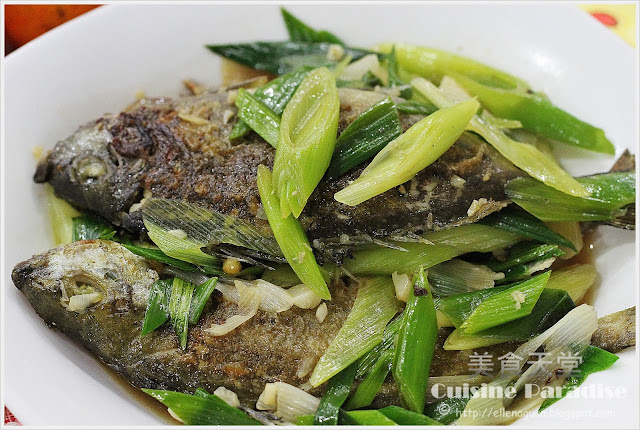
Pan-fried White Spotted Rabbitfish With Leeks

Chinese New Year is just a few days away and I believe every household is busying with preparing the food, beverage, clothing and etc before the coming New Year. Or perhaps some of you are having reunion dinner this weekend while everyone is off work and available at home. For Teochew family like us, our Chinese New Year reunion dinner can never go without this “Pan-fried White Spotted Rabbitfish With Leeks” when my dad was still around.

If you often frequent those Teochew Porridge stalls in food centre or coffee shop, I am sure you will be familiar with their signature Steam White Spotted Rabbitfish(清蒸白肚鱼) which goes well with their traditional dipping sauce make with "salted bean paste(豆豉), minced garlic and cut chilies".

As you know Leeks belong to the same category as onion family where you will link to those thick stalked European leeks that are commonly found in supermarkets which have a mild sweet flavor that is suitable for making soup or pie. But as for Chinese leeks on the other hand they are smaller and thinner which resemble thick scallion that has strong flavor, which makes them a staple ingredient in most Chinese cooking. Also most of the Chinese believe that by storing more LEEKS()at home it means you will have more money to COUNT()as both have the same pronunciation in Mandarin.

  Every year during Chinese New Year these “White Spotted Rabbitfish(白肚鱼)” will be highly in demand at both the wet and local supermarkets. And for your information the price of these fish can go as high as up to S$35.00 – S$40.00 per kilogram. These fish also has another name known as “Pei Tor” and by eating it most of the Chinese believe it brings good luck and prosper during the year. Also during this breeding period of the year, these fish are big in size and they do comes with roes that are particularly relished too.

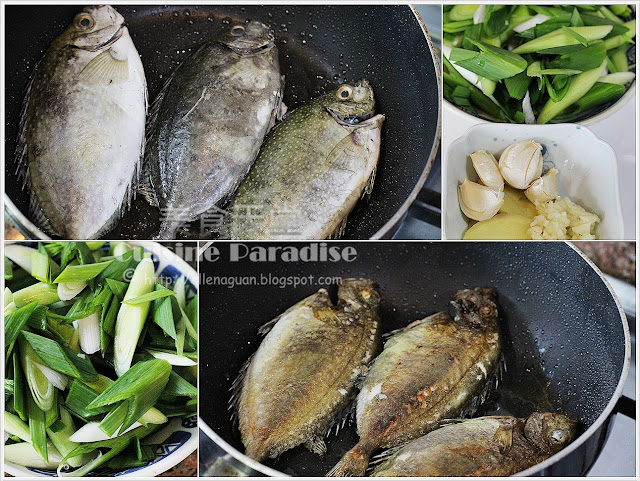
Here is a photo of  the steps on preparing this dish.

Ingredients: (serves 2)
3 - 4 Medium Size (350g) White Spotted Rabbitfish
3 Stalks of Chinese Leeks, cut into diagonal sections
2 Slices of Ginger
1 Teaspoon of Minced Garlic
1 Teaspoon Chicken Stock Powder
80ml Hot Water

Method:
1. Clean and rinse the fish, pat dry with kitchen paper towel and set side.
2. Preheat a frying pan with 1 tablespoon of oil, pan-fry the fish on both side for about 3 minutes under medium heat or till slightly golden brown. Dish up.
3. Using the same pan add in ginger and minced garlic, sauté till fragrant before adding the sliced leeks.
4. Continue to stir-fry the leeks for another 2 – 3 minutes until soften add in 80ml of hot water and chicken stock powder to taste.
5. Place the cooked fish on top of the leeks and simmer for another 1 minute on medium low heat, carefully give it a quick stir in between to let the fish absorb the flavour from the leeks mixture.
6. When done dish up and serve with hot steamed rice.


If you do cooked this white spotted rabbitfish at home, it would be great if you would like to share with us how you prepared them. Because for us, we only cooked it with leeks or steam and eat it fresh with light soy sauce.


Read More...

Saturday, 29 January 2011

Sweet And Savory Nian Gao - 双味年糕

In Singapore the most common way to eat Nian Gao(年糕) is to cut it into thin slices, sandwich it with either sweet potato, yam or both then dipped them in flour batter and deep-fried till golden and crispy. Or some of you might even just like to have it plain on it’s own with Chinese Tea. In this post I will share two different methods of eating Nian Gao which I learnt one of it from f an elderly lady selling Nian Gao near my area.

Nian Gao(年糕) or Chinese New Year's Sticky Cake is a sweet dessert/snack prepared from glutinous rice and consumed during Chinese New Year. Although this cake be eaten whole year round but it is usually consume in Chinese New Year as it symbolized good luck, harmony and raising oneself higher in each coming year. There are also different ways of preparing and cooking Nian Gao depending on the country and its culture.

Since this Nian Gao is for consuming purpose rather than "pray", the stall aunty purposely choose one that is freshly steam on that day.  She told me to reheat a portion of the sticky cake for a few minutes before coating it with some fresh grated coconut which reminds me of the Nonya Kueh Kosui.

This can be a great and fun family after meal dessert where everyone can gather around the dining table with either chopsticks or lollipop sticks to enjoy this fulfil time.

Ingredients: (serves 4)
1 Small Nian Gao, wrapped in banana leaf, 10cm wide
1 Cup Freshly Grated Coconut
A few Pandan Leaves, optional
Pinch of Salt

Method:
1. Clean and rinse the pandan leaves, tie it into a knot and set aside.
2. Put the grated coconut in a large steamer plate together with pandan leaves and Nian Gao on the side.
3. Steam it over medium heat for about 5 minutes or till Nian Gao soften.
4. When done stir in pinch of salt to the hot grated coconut and mix well.
5. Use either small teaspoon or lollipop sticks, scrap/twirl the stick till you get a some nian gao stick on it then roll/dip nian gao with grated coconut and eat warm.


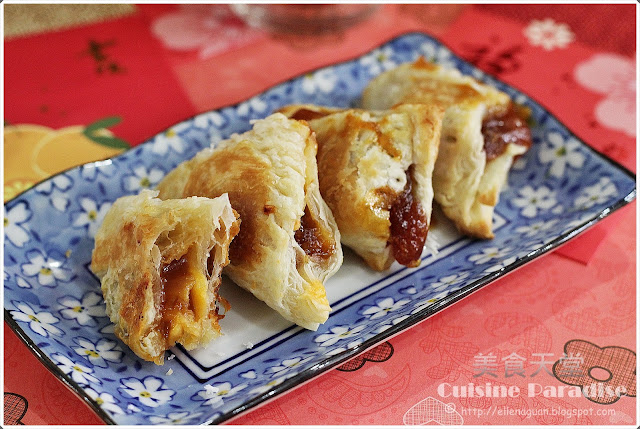
If you don't like the idea of using grated coconut perhaps you could to try this western style of "Cheesy Nian Guao Puff" which I am sure it will be a great snacks for both kids and adults during Chinese New Year gathering. The ingredients for this snack is very simple and you can easily get them in supermarket too.

Ingredients: (makes 8 puffs)
8 Cubes of 1-cm  each Nian Gao
2 Sheets of Plain Prata Pastry
1/2 Cup of Shredded Mozzarella Cheese

Method:
1. Remove the plastic sheet of the prata pastry(work one sheet at a time) and cut it into 4 equal portions.
2. Place one cube of Nian Gao with some shredded mozzarella cheese on each portion then quickly fold it into a triangle parcel by using a fork to seal the edge of the parcel.
3. Working quickly to avoid the pastry to defrost and became sticky to handle.
4. Place the parcel on baking tray that is line with aluminium foil then bake it in oven toaster for about 10 minutes or till golden brown. (turn a few times during baking to get a nice and even golden brown and crispy outer skin)
5. Serve warm with a cup of hot or chilled tea.


Note:-
~ You can replace Mozzarella Cheese with sandwich slice cheese by cutting each square into 4 portions.


This is indeed another new way to eat your Nian Gao where you stuff the prata parcel with cheese and nian gao instead of the usual deep-fried style with sweet potato and yam.  I remember when I was young, my dad used to fry Nian Gao together with some beaten egg to make a sweet omelette. So what about you? Do you have any special recipe of eating this auspicious sweet Nian Gao during Chinese New Year. If yes, do share with us your thoughts.


Read More...

Friday, 28 January 2011

Lotus Roots And Tricolour Beans Soup

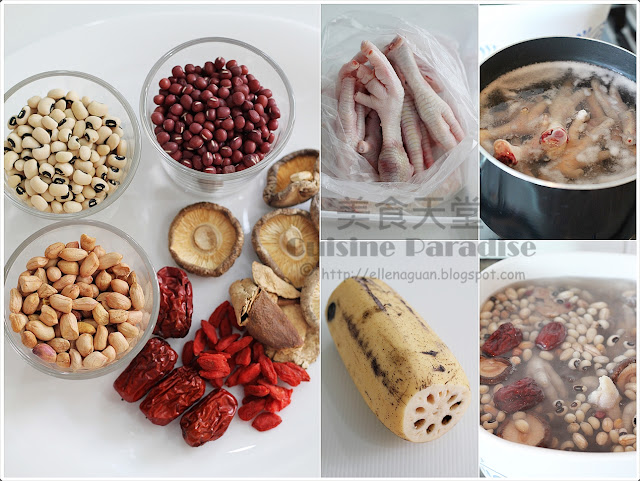
This Tricolour Beans Soup is replicated base on my memory from the “Hearty Soup” that I always ordered during my visit to “Fragrant Hong Kong Pork Rice” at Hong Lim Food Centre(behind Chinatown Point Mall). I am sure for those who frequent that food centre during lunch hours would have at least tried one of their varieties of steam rice and this homecook soup. If I remember clearly their soup consists of peanuts, black-eyed peas, chicken feets, dried mushroom, dried shellfish and etc that make it full of flavour.

As for my home consume version I have added lotus roots, red beans, red dates, wolfberries and dried tangerine peel to it. Below is my recipe for this soup.

Ingredients: (Serves 2 - 4)
1 Medium Section Lotus Roots, 150g
10 Pieces of Chicken Feets
50g Red Beans
50g Soup Peanuts
50g Black-eyed Beans
5 Pieces of Dried Shiitake Mushrooms
1 Piece of Dried Tangerine Peel, soaked till soften
4 - 6 Red Dates
1/2 Tablespoon Wolfberries
1.8 Litres Hot Water

Method:
1. Mixed all the beans together in a big bowl, add hot water and soak them for about 5 minutes till a bit soften. Rinse a few time, remove any decay beans and set aside.
2. Soak the dried tangerine peel in water till soften, use a small spoon scrapped out the white pith from the peel to prevent bitterness.
3. Blanched the chicken feets in boiling water, rinse well and get ready a soup pot with 1.8 litre of water.
4. When the water boils, add in all the ingredients except wolfberries and let it simmer over medium heat for 5 minutes before low the heat and let it simmer for about an hour or so till the beans are soften and soup is flavourful.
5. Add in wolfberries, season with salt and serve.

Note:-

~ You can replace the chicken feets with chicken drumsticks, pork ribs or etc.


We loves the taste and texture of this soup especially with a hint of refreshing fragrant from the tangerine peel. But if you feel that these soup takes up too many ingredients that is not available from your pantry, you can always mix and match with your own preference according to the ingredients you have. But if you have tried and love the SOUP from "Fragrant Hong Kong Pork Rice", this recipe is worth giving a try.


Read More...

Tuesday, 25 January 2011

Cassata with Walnuts

Cassata is a traditional sweet treat from a town in Italy. Sometime it may also refer to a Neapolitan ice cream top with candied or dried fruit and nuts. This dessert is made using sponge cake moistened with fruit juice or liqueur then layered with candied peel, chocolate or vanilla ice cream together with chopped nuts.

Continue from last week Philips, MyKitchen (www.philips.com.sg/kitchen) recipe post on the "Baked Sweet Chili Chicken", this week let's look at some sweet dessert which you can prepare ahead and served after meal to impress your guest.


Cassata with Walnuts


Preparation Time: 15 Minutes                        Baking Time: 30 Minutes

Ingredients For Batter:
250g Sugar
2 Eggs
1 Tablespoon Vinegar
375g All-purpose Flour
50g Cocoa Powder
2 Teaspoons Baking Powder
10 Tablespoons Olive Oil
200ml Boiling Water
A Pinch of Salt

For the Filling:
1 Litre Vanilla Ice Cream
4 Tablespoons Walnuts, chopped

For the Chocolate Fudge:
200g Milk Chocolate
125ml Cream
2 Tablespoons Cognac
500ml Sour Cream
6 Tablespoons Sugar

Method:
1. In the mixer, beat the sugar, eggs, olive oil and vinegar.

2. Add the flour, baking powder, baking soda, chocolate, salt and then the boiling water.

3. Place on a greased tray. Bake at medium heat (180°C) for approximately 30 minutes. Set aside and let it cool completely.

4. To make the fudge, melt the chocolate and add the cream and the cognac. To make the frosting, beat the cream and sugar in the mixer until you have whipped cream.

5. To assemble, line a rectangular baking dish with baking paper. Add alternate layers of ice cream, chocolate cake, chopped walnuts and chocolate fudge.

6. Decorate with green and red M and Ms and mint leaves.


Tips:
If you don’t want to use spirits, use milk instead of cognac. Or for variation, try using chocolate chip ice cream instead of vanilla ice cream.


Although I have not I have not tested this recipe yet but it look rather easy to prepare from the list of ingredients and instructions shown. Perhaps I would get a ready-baked sponge cake from bakery (to shorten the preparation time or those without oven can also use this shortcut) to try assemble this traditional Italian dessert.

For more quick and easy recipes you can refer to Philips MyKitchen at www.philips.com.sg/kitchen or stay tune for next week post on Chinese New Year - 5 Treasure Soup.


Read More...

Friday, 21 January 2011

Babi Pong Teh - Braised Pork with Salted Bean Paste

Nyonya Cuisine reflects the cultural mix of the community from Malay ingredients such as lemongrass, glangal, and chilies with Chinese pork in basic style of food preparation. In modern society we could easily prepared authentic traditional Nyonya cuisine from those ready packed spices or using a food blender to blend the spices instead of pestle or grinding stone.

To be frank as a Teochew and my Granny being a Nyonya I have never appreciate most of her Nyonya dishes during the days when she was around. And in this case, I don’t really have deep impressions on how she prepares her signature dishes. From my memories, I only remembered her  “Acar”, “Belacan Stuffed Fish”, “Pengat” and this “Babi Pong Teh”.

If you have watched MediaCorp drama "Little Nyonya (小娘惹)" which is very popular in year 2008 till now, you would be familiar with this "Babi Pong Teh" dish which is being prepared by one of the leading actress in the drama. Although the ingredients might various from each recipes but the key ingredients would be more or less the same using Pork Belly and Salted Bean Paste.

These are the basic ingredients for preparing this homecook Nyonya Braised Pork Belly dish.

Ingredients: (Serves 2 - 4)
350g Pork Belly, cut into 3cm pieces
100g Shallots
50g Garlic
30g Salted Bean Paste
1/2 Tablespoon Dark Soy Sauce, for colour
1 Tablespoon Olive Oil
300ml Hot Water

Seasoning:
20g Sugar
1/2 Teaspoon Chicken Stock Powder
Salt and Pepper To Taste


Method:
1. Remove the outer skin of the shallots and garlic then blend them together with salted bean paste till it form a smooth paste.
2. Heat 1 Tablespoon of oil in small saucepan, add blended paste and fry over medium low heat till fragrant and slightly golden brown.
3. Add pork belly and dark soy sauce and continue frying for 1 minute and pork is evenly coated with the bean paste.
4. Add in hot water to cover pork belly, stir in seasoning and simmer over low heat for 1 hour or until pork is tender.
5. Serve hot with steamed rice.


This is a very authentic dish that can be easily found in every Nyonya household or even in the menu of any Nyonya restaurant. The taste of this dish should be slightly sweet with a hint of saltiness from the salted bean paste and it gives out a great aroma braising this dish with these blended ingredients. For a healthier version you could also replace the pork belly with chicken pieces or chicken wings.


Read More...

Thursday, 20 January 2011

Lotus Seeds Soup - 莲子羹

During the Eve of Chinese New Year, usually most of the household would prepare a sweet dessert to be served during the 1st Day of Chinese Luna New Year as an auspicious treat for the family or relatives. The common sweet dessert(Tong Shui) are Cheng Teng(清汤), Red Bean Cream(红豆沙), Lily Bulb and Lotus Seeds(百合莲子), Glutinous Rice Balls Soup(汤圆) and etc.

For a Teochew household like us, we usually have our favourite "Yam Paste(Orr Nee)", "Cheng Teng(清汤)" or "Lotus Soup(莲子羹)" which is shown in this post. Last year, I made Glutinous Red Date With Osmanthus Syrup for Chinese New Year dessert but this year I would like to share this Lotus Soup post with you.

This photo shows some of the ingredients and steps in preparing our all-time favourite dessert during Chinese New Year.

Ingredients: (serves 6 - 8)
300g Dried Lotus Seeds
150g Brown Sugar(in pieces form)
30g Brown Sugar
2 Tablespoons Caster Sugar
1 Bundle of Pandan Leaves
2.5 Litres of Water
1 1/2 Tablespoons Potato Starch(生粉) + 1 Tablespoon Water


Method:
1. Bring a small pot of water to boil, add dried lotus seeds and cook for 5 - 8 minutes or till soften.
2. Drain, rinse and remove the green sprout from each seeds and set aside.
3. Use a big soup pot, bring 2.5 litre of water to boil, when water comes to boil add in pandan leaves and cooked for about 5 minutes before adding it the pieces of brown sugar.
4. While waiting for the water to boil, season the cooked lotus seeds with 2 tablespoons of caster sugar and set aside.
5. When the pieces of brown sugar melt, removed the pandan leaves, add in seasoned lotus seeds and simmer on medium low heat another 15 - 20 minutes till the lotus seeds achieves your desire texture when bite.
6. Next slowly add in the remaining 30g of brown sugar to sweeten the dessert to your liking.
7. Stir in potato starch mixture over low heat to thicken the soup accordingly.
8. Remove from heat and serve warm.


Lotus Seeds(莲子)are actually nuts from the lotus plant that are commonly found in Asia. The typical lotus seed is small, round and slightly white in appearance that is usually sold in dried and pre-packaged. The most common use of the seed is in the form of a paste for making moon cakes and bun or sometime they are found as one of the ingredients in Asian dessert or soup.

It is believed that when using lotus seeds to cook soups, congee or dessert, it actually act as a cooling tonic that "clears heat" according to the Chinese Physician. being sweet and neutral, they have been known to tonify the spleen, reinforce the kidneys and nourish the blood too. But within the seed lies a "green sprout" that is quite bitter and it is usually removed when lotus seeds are use in sweet dessert.

No matter which Chinese New Year dessert you preferred or made at home I am sure everyone would love to have something Auspicious for their family. So if you have some special dessert which you prepared for Chinese New Year do share with us, if you don't have a blog you can Email me your recipe and I would be most delighted to do a [Guest Post] on your behalf


Read More...

Tuesday, 18 January 2011

Baked Sweet Chili Chicken

Continue from last week Philips, MyKitchen (www.philips.com.sg/kitchen) recipe post on the "Red Cabbage Salad with Filet of Duck Breast", this week I would like to share with you this super quick and simple Sweet Chili Chicken which is perfect for BBQ function or served as finger food during party.


Sweet Chili Chicken Mid-Joint


Preparation Time: 60 Minutes                  Cooking Time: 25 Minutes

Ingredients: (Makes 10 Mid-Joint)
1/2 Tablespoon honey
2 Tablespoons Sweet Chili Sauce
1 Tablespoons Soy Sauce
10 Chicken Mid-Joint Wing

For working mothers who don't have the luxury of time to spend an hour marinating the chicken. The quicker way would be doing it the night before or spending around 5 - 8 minutes in the morning preparing it ahead and leave them in the fridge till evening time.

Method:
1. In a large bowl, mix together the honey, sweet chili sauce and soy sauce.
2. Place chicken mid-joint wings into the bowl. Cover and refrigerate at least 1 hour.
3. Preheat oven to 180 degree on grill function, arrange the mid-joint wings on baking tray and bake for about 10 minutes.
4. Turn the wings over, baste with marinade and continue to bake for another 10 minutes.
5. Adjust the oven to 200 degree fan-forced mode on upper and low heat, bake for the last 5 minutes to achieve the golden and char-grilled colour.


ORIGINAL RECIPE FROM PHILIPS (MyKitchen):

Sweet Chilli Chicken Drumsticks


Preparation Time: 60 Minutes                  Cooking Time: 20 Minutes

Ingredients: (Makes 12 Drumsticks)
1 Tablespoon honey
5 Tablespoons Sweet Chili Sauce
3 Tablespoons Soy Sauce
12 Chicken Drumsticks

Method:
1. In a large bowl, mix together the honey, sweet chili sauce and soy sauce. Set aside a small dish of the marinade for basting.
2. Place chicken drumsticks into the bowl. Cover and refrigerate at least 1 hour.
3. Preheat barbecue for medium high heat.
4. Lightly oil the barbecue cooking grate. Arrange drumsticks on the grate and cook for 10 minutes per side, or until cooked through.
5. Baste frequently with the reserved sauce during the last 5 minutes.


With such a quick and easy recipe above I am sure you would like to explore more recipes from Philips MyKitchen at www.philips.com.sg/kitchen for coming Chinese New Year too. Stay tune for more recipe idea from MyKitchen on next week post which I would share a recipe for a delicious dessert.


Read More...

Saturday, 15 January 2011

Bunny Pineapple Tarts

Chinese New Year is just about 3 weeks or less from now and most of my social network friends from facebook and twitter have already started their Chinese New Year Bakes with Pineapple Tarts, Kueh Bangkit, Peanut Cookies, Kueh Lapis and etc since early this week. For me every year I would definitely baked our family favourite pineapple tarts which I would giveaway to some relatives and close friends.

Since this coming Chinese New Year would be the year of "RABBIT", I decided to make some special "BUNNY" theme pineapple tarts to suit this year Chinese Horoscopes theme. If you have followed this blog for long, you would have remember about my last year "Tiger" theme tarts for the year of "TIGER" too (you could read more HERE).

This year I have made two different types of "Bunny" shape tarts which comes in either "Open" or "Closed" tart version. For the "closed tart", I have wrapped the pineapple fillings with a thin layer of dough skin and pressed it into a bunny mould to achieve the shape shown above.

For this pastry recipe, I have adapted another version from one of my favourite blogsite know as The Little Teochew which some of you might have read most of her posts before. 

Ingredients:
(adapted mainly from The Little Teochew)
400g Plain Flour
50g Corn flour
1/4 (heaped) Teaspoon Salt
280g Cold, Unsalted Butter (do not allow it to soften)
3 Egg Yolks, beaten
3 Tablespoons Cold Water (or iced water)
5 Tablespoons Icing Sugar
1/2 Teaspoon Cognac
For glaze:
1 egg yolk + 1 Tablespoon water, beaten

Getting the tarts ready by gazing and topping it with pineapple fillings before sending them into the oven.

Method:
1. Refer to the original recipe from Little Teochew for the steps on making the pastry HERE.
2. When the dough is done divide it into smaller portions(example 3 portions) and place each portion in a plastic bag and slightly flatten it before chilling in the fridge for about 10 minutes or so.
3. While working with the pastry, you can use 1 portion at time and keeps the remaining in the fridge to prevent the pastry from oozing oil due to the warm temperature.
4. Roll the pastry to your desired thickness and cut out dough using bunny or normal traditioanl pineapple cutter.
5. Arrange cutouts neatly onto baking tray with some spacing apart.
6. Once the tray has filled up with tart shells, glaze them with beaten egg yolk mixture and placed the pre-rolled pineapple jam balls onto each tart shell.
7. Bake in preheated oven at 160 degrees for about 20 minutes. Rest baked tarts on tray for about 2 minutes before transferring to cooling rack.


From the enquiries of some readers, these are the two mould that I used for making the Bunny Pineapple Tarts. For the open tart bunny, you could get any bunny design cookie cutters from baking stores or even Daiso. But as for the closed tart version, you have to get this bunny design egg mould which I got it from one of the online Bento spree years back.

As for the pineapple paste, you could either prepared your own using fresh and good grade pineapples together with sugar, some spieces and cooked it over low heat till it turns into a thick golden colour paste. Or in order to save time you could always get those ready made paste from local supermarket too. Here are some suggestions shared by our fanpage readers on the choice of "Butter" and "Pineapple Fillings" for your reference.

Finally after spending a few hours in the kitchen doing all the rolling, cutting, egg washing and etc. Here are our Chinese New Year Bunny Pineapple Tarts for the year of Rabbit. And I hope this new creation of mine would give you some ideas on what to bake as gifts or treats for the coming New Year to impressive your guests. And also I am submitting this post to "Aspiring Bakers #3: My Favourite CNY Cookie! (January 2011)", hosted by Jess of j3ss kitch3n at this link HERE.


Lastly perhaps if you like this post, do help by leaving a comment(s) on which "Bunny" do you prefer? Closed or Open version? For us my boy prefers the open-tart bunny where he describe the pineapple fillings symbolised as a bag of GOLD on the bunny's tummy :)


Read More...

Thursday, 13 January 2011

Red Cabbage Salad with Filet of Duck Breast

Talking about "Philips" brand I am sure most of you would automatically relates it to their popular electrical appliances such as Television, Hi-Fi System, Household Products and etc. Recently, Philips launched a new on-line recipe resource known as "MyKitchen" (www.philips.com.sg/kitchen), and it has since been receiving popular reviews in the local media because it has a wide variety of recipes catering to all palates including the Asian delights. For example you could find recipes range from Korea, Japan India, Asian and etc that suits your family and guests.

Since Chinese New Year is around the corner, perhaps you would be keen to take a peep at their MyKitchen website for more recipe ideas to impress your guests with restaurant like cuisines. Here I would share with you FOUR different cuisine which I find it interesting and easy to prepare with. First we shall have :-


Red Cabbage Salad with Filet of Duck Breast


Preparation Time: 20 minutes + 30 minutes to marinade

Ingredients: (Serves 2)
400g Red Cabbage
2 - 3 Tablespoons Raspberry Vinegar or Red Wine Vinegar
3 Tablespoons Walnut Oil
1 Teaspoon Dried Thyme
Freshly Ground Black Pepper
1 Filet of Tame Duck Breast (300-400 g)

Method:
1. Heat 1.5 l water to 100°C in your Philips kettle. Remove the hard core from the cabbage and finely shred the red cabbage (in a food processor or with a grater).
2. Put the shredded cabbage in a colander and pour on the boiling water. Drain well.
3. Next beat the vinegar and walnut oil in a bowl with the thyme, salt and pepper to taste to make a dressing. Mix in the warm, red cabbage and leave to stand for 30 minutes.
4.Cut a diamond pattern into the skin side of the duck breast every 1 cm. Lay the duck breast skin side-down in a frying pan and fry on a high heat for 6-8 minutes until crisp and brown (no extra fat is needed, this melts from the skin).
5. Turn the duck breast over and fry the other side until nice and brown. The meat may be rare (rosé) on the inside. Let the duck rest briefly.
6. Meanwhile scoop the red cabbage salad onto 2 plates. Slice the duck into thin slices and arrange these on the red cabbage salad. Tasty with brown bread or roast potatoes.


With such a quick and easy to follow recipe you could easily whipped up restaurant standarad of food in less than an hour. So do pop-by MyKitchen at www.philips.com.sg/kitchen for more ideas to pamper your family today.


Read More...

ShareThis